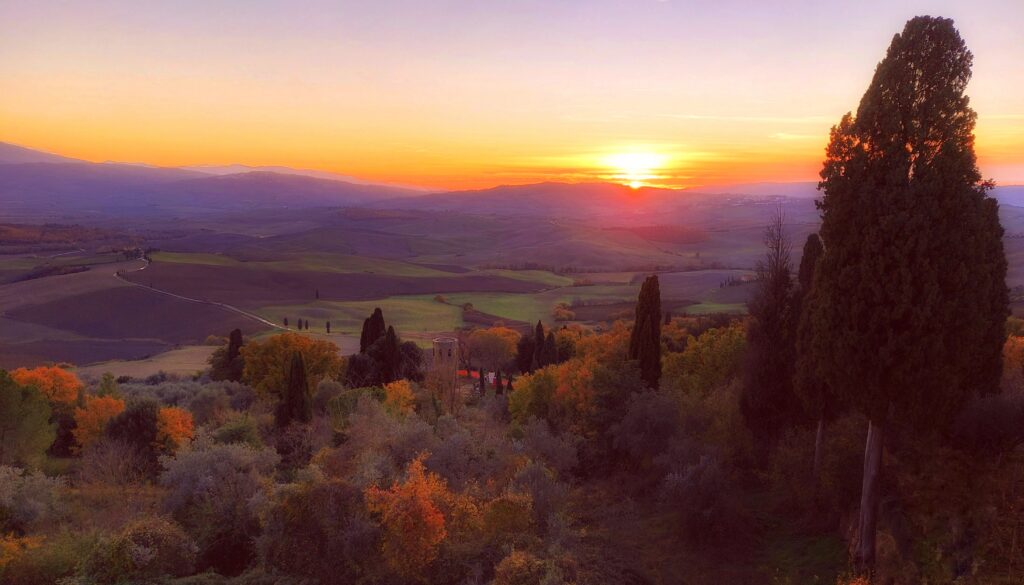
Tuscany is one of Europe’s most rewarding golf regions. Within barely two hundred kilometres from north to south, you’ll find historic layouts threaded through Chianti olive groves, seaside courses overlooking the Tyrrhenian, and contemporary resorts tucked into the rolling clay hills around Siena. This site is conceived as an independent guide, written for travellers who want to plan a Tuscan golf holiday using verified, on-the-ground information — without the commercial pressure of a booking portal.
We bring together course profiles for the region’s 18-hole tracks, the smaller layouts that welcome beginners and juniors, and itineraries that pair golf with food, wine and art. Our perspective is that of the visiting golfer: what a green fee actually buys you, how to move between Florence and the coast, and which months turn every round into a pleasure rather than a battle with the weather. The site’s name nods to Golf Club Centanni in Bagno a Ripoli, a small club just outside Florence that closed at the end of 2024; we preserve its story on a dedicated page.
Why play golf in Tuscany
The first reason is the climate. Central Tuscany enjoys a golf season that stretches from March deep into November, and the mild winters along the coast mean you can play almost year-round between Punta Ala, Argentario and Tirrenia. The sweet spots are April to June and September to October: temperatures of 18 to 26 degrees Celsius, comfortable humidity, and long daylight hours. High summer is best tackled either at sunrise or in the late afternoon, when a sea breeze on the coast or a hillside breeze inland takes the edge off the heat.
The second reason is the landscape. Few places in the world let you stand on a tee with a 16th-century farmhouse, a Romanesque parish church or a ridge of cypresses framing your shot. The designers who have worked in Tuscany — Blasi, Hawtree, Robert Trent Jones Jr., Rocky Roquemore — have generally chosen to follow the existing contours rather than impose the heavy earthworks typical of American resort golf. You play within the landscape here, not on top of it.
The density of courses is a third pull. Within 60 kilometres of Florence you’ll find at least six 18-hole layouts and roughly ten shorter tracks; widen the circle to Pisa, Lucca and Prato and the count climbs above fifteen. On the coast, the triangle of Punta Ala, Argentario and Saturnia concentrates some of the most decorated resort courses in the Mediterranean. Inland, Siena and the Maremma round out the picture with destinations such as La Bagnaia and Saturnia, where golf is woven together with thermal spas, local wine and a serious culinary tradition.
Finally there is tradition. Ugolino, in Impruneta just south of Florence, was founded in 1934 and is the oldest course in Tuscany — and one of the oldest in Italy. For almost a century the region has hosted Italian Golf Federation (FIG) events, junior academies and a deep amateur scene that has produced players of national standing. You feel that grounding in the clubs themselves: clubhouses converted from old farms, secretaries who have known their members for decades, and a culture of golf that has none of the showy luxury of some other destinations.
The regions of Tuscan golf
Florence and Chianti
The Florence metropolitan area is the historic heart of Tuscan golf. Within a short drive of the city centre you’ll find Ugolino at Impruneta, Le Pavoniere near Prato, Poggio dei Medici in the Mugello, and the courses scattered along the Arno valley. Chianti adds Castelfalfi, perched on the ridges between Florence and Pisa, with both an 18-hole and a 9-hole layout. It’s the natural choice if you want to combine golf with art cities and tastings at the great Chianti Classico cellars. Read the full guide.
The coast: Versilia, Tirrenia and the Maremma
The coastal strip offers a Tuscan take on seaside golf. Cosmopolitan in Tirrenia gives you a flat, walkable layout. Versilia Golf Club in Pietrasanta winds between umbrella pines and irrigation canals. Punta Ala carries the history of the Maremma with one of the region’s most atmospheric clubhouses. Further south, Argentario Golf Resort commands the headland of the same name with a Hurdzan-Fry course that has collected a long list of international awards. This is the side of Tuscany for golfers who want a round and a swim on the same day.
Siena and the Val d’Orcia
Southern Tuscany is the region’s most recent golf frontier. Royal Golf La Bagnaia, just outside Siena, has turned a centuries-old estate into a fully international 18-hole resort; Saturnia Tuscany Golf sits beside the famous hot springs of the same name. This is the right area for longer stays, where rounds of golf alternate with Montalcino, Pienza and the free thermal pools of the Val d’Orcia.
The best-known courses
Golf Club Ugolino — Impruneta (FI)
Founded in 1934, Ugolino is the oldest course in Tuscany and one of the historic golf clubs of Italy. Eighteen holes, par 72 in the standard configuration, originally laid out by Blandford and Gannon and progressively refined over the decades. The course climbs and falls across the Impruneta hills, between century-old olive trees and dry-stone walls; the par-3 sixteenth, with its green sitting almost on the edge of a drop, is one of the most photographed holes in Italy. The clubhouse occupies a period villa with views across Chianti.
Castelfalfi — Montaione (FI)
Castelfalfi is today the largest golf complex in Tuscany: 27 holes in total, with an 18-hole Mountain Course and a 9-hole Lake Course, set inside a thousand-hectare resort built around a restored medieval village. The par-73 Mountain Course alternates rolling fairways with greens defended by deep bunkers; the Lake Course is better suited to mid- and higher-handicap golfers. The resort runs a teaching academy, a putting green and a well-stocked pro shop.
Argentario Golf Club — Monte Argentario (GR)
Eighteen holes, par 71, designed by the Hurdzan-Fry studio and opened in 2006 on the eastern flank of the Argentario promontory. The course is considered one of the most scenic in Italy, with the Orbetello lagoon and the islands of the Tuscan Archipelago in almost constant view. Sustainability is taken seriously here: irrigation uses treated wastewater, the fairways are sown with drought-resistant bermuda grass, and the out-of-play areas have been replanted with native Mediterranean scrub.
Royal Golf La Bagnaia — Siena
Built into a historic agricultural estate just outside Siena, La Bagnaia is an 18-hole par-71 course designed by Robert Trent Jones Jr. The layout follows the swells of the Sienese clay hills, with marked elevation changes and fairways framed by stands of holm oak and Turkey oak. The resort offers a five-star hotel, a spa and a Michelin-starred restaurant, and regularly stages FIG events on the national calendar.
Golf Club Le Pavoniere — Prato
Eighteen holes, par 72, designed by Arnold Palmer and opened in 1986, Le Pavoniere is one of the most technical courses in northern Tuscany. It lies on the Prato plain, with broad sheets of water in play on seven holes; the greens are generously sized but are protected by water hazards on the line of approach, rewarding a long, accurate ball. The club has a strong competitive identity and runs federation events on a monthly basis.
Cosmopolitan Golf & Beach Resort — Tirrenia (PI)
Eighteen flat holes, par 72, a few hundred metres from the Tirrenia coastline. Designed by David Mezzacane and extended in the 2000s, the course suits players who prefer a relaxed walk on generous fairways. The resort combines a hotel, a beach club and a restaurant, and is particularly popular with Northern European golfers looking for a winter destination: from December to February the average temperature sits around 12 to 14 degrees and the greens stay in genuine playing condition.
The story behind our name
The domain golfclubcentanni.it originally belonged to Golf Club Centanni ASD in Bagno a Ripoli — a small 9-hole pitch & putt founded in 2003 by the Bianchi family, on the same land that had hosted their family restaurant, Centanni, since 1962. The club closed at the end of 2024, after more than twenty years of activity, when the founders’ children chose not to continue running the operation and the property passed to new owners who are now converting it for residential use.
We’ve kept the original name and devoted a page to the club’s history because we believe Centanni was a small but genuine chapter in the sporting life of the Florentine countryside: an accessible course, a junior golf school, and a charity Memorial supporting the local Red Cross. Read the full story of Golf Club Centanni.
Plan your trip
- Explore the courses — our complete 2026 guide, with detailed profiles of every 18-hole and 9-hole layout in the region.
- Read the history — Golf Club Centanni of Bagno a Ripoli, from its origins to its closure.
- About this project — our editorial line, and why we operate as an independent guide.
Enjoy the read — and, above all, enjoy your golf in Tuscany.